forex Forex Strategy for Dummies: 2016

Thursday, December 22, 2016

TIP: What are the best circumstances of the day to exchange certain sets?

GBP/JPY can have gigantic moves amid the Asian session, however it's hard for dealers situated outside the Asian zone to keep up and benefit from it. All things considered, it continues moving with its run of the mill unpredictability all day and all night.

Thus, the EUR/USD and the GBP/USD offer decent specialized set-ups comfortable begin of the Frankfurt and London markets which regularly sets the tone for whatever is left of the day. These sets frequently show continuation moves, the alleged 'second-legs', amid the morning session in New York when both sessions, the European and the American, cover and numerous US Dollar related practical news are distributed.
The motivation behind why we see enormous moves at the London open is on the grounds that London is the world's capital of Forex exchanging, and when those huge brokers begin tossing their weight around, the market reacts with unpredictability. Additionally U.K. monetary pointers are regularly discharged at that time, adding to the general atmosphere of high volume and instability.

Monday, December 19, 2016

Forex Pinbar

Pinbar Forex Trading System — a popular strategy for entering and exiting positions that is based on the particular candlestick pattern and the following price action. The Pinbar (also known as "Pin-bar" or "Pin bar") pattern was first introduced by Martin Pring in his Pring on Price Patterns.

Features

  • Conservative strategy offers low-risk high-yield opportunities.
  • No-loss rate is pretty high if break-even is applied.
  • Rare occurrence.
  • Timing is critical.
  • Support/resistance is difficult to formalize.

Strategy Set-Up

Any currency pair and timeframe should work, but longer-term timeframes (such as H4, D1 and W1) should work better.

Pinbar Set-Ups:

Pinbar Set-Ups
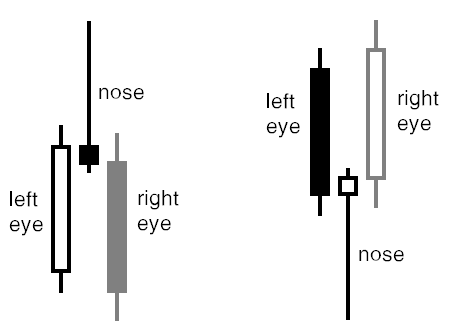
The pattern consists of three bars: the left eye, the nose and the right eye. The left eye should be a bar up for the bearish Pinbar pattern or a bar down for the bullish pattern. The nose bar should open and close inside the left eye, but its high (or low, for the bullish set-up) should protrude much farther than the left eye's high (or low). Both the nose bar's open and close should be located in the bottom (top, for the bullish set-up) 1/4 of the bar. The right eye is where the trading happens.
An additional condition for the good pattern set-up is the strong support/resistance level formed either behind the eyes or near the point of the nose. The stronger are the support/resistance levels you incorporate into this pattern, the more accurate it will be.
You can use the MetaTrader Pinbar Detector indicator to automate the Pinbar pattern detection.

Entry Conditions

Aggressive entry option is to enter a position when in the right eye price retreats behind the left eye's close level.
Conservative entry point is below (above for bullish set-up) the nose bar.

Exit Conditions

Conservative stop-loss can be set behind the nearest support/resistance level behind the eyes. A less conservative approach would be to set stop-loss to immediately behind the nose bar point (in this case, your reward/risk ratio may suffer).
Conservative take-profit can be set immediately after the left eye low (high for the bullish set-up). Aggressive take-profit level may be placed farther — to the next strong support (resistance for bullish positions) level.

Examples

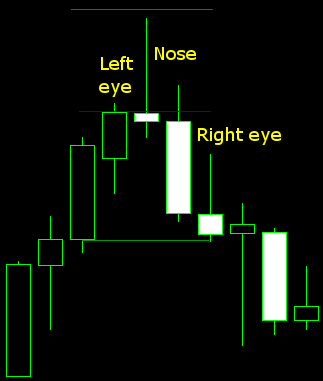
Bearish Pinbar Set-Up:

This is an example of the aggressive set-up. The entry point (blue line) is positioned at the left eye close (price retreated for that entry). Stop-loss (red line) is placed at behind the point of the nose bar (in this situation, even conservative stop-loss wouldn't be hit, as the price pull-back during the right eye happened before the entry). Take-profit (green line) is set at the nearby support level and is easily filled.
Bearish Pinbar Set-Up Example Chart

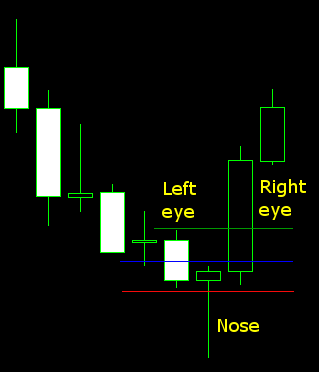
Bullish Pinbar Set-Up:

This is an example of the conservative set-up. The entry point (blue line) is placed just behind the nose bar. Stop-loss (red line) is below the left eye. Take-profit (green line) is just above the left eye.
Bullish Pinbar Set-Up Example Chart

Forex Scalping

Scalping Forex strategy — is a simple trading system that relies on very close targets, extremely low stop-loss and a lot of positions opened and closed during a short period of time. Not all Forex brokers allow scalping and not all who allow are good to scalp with. Scalping may not be suitable for all traders and, personally, I do not recommend scalping to anyone. The most simple scalping Forex trading system is presented here.

Features

  • Nice profits for lucky (intuitive) traders.
  • No need to pay attention to technical, fundamental or any other analysis.
  • Spreads eat a big part of profit.
  • Reward/risk ratio is usually too low.
  • Not all Forex brokers allow scalping.
  • Requires a lot of time for trading and monitoring.

How to Trade?

  1. Currency pairs with a lot of intraday volatility but low spreads are recommended (EUR/JPY, GBP/USD, EUR/USD and USD/JPY are good examples).
  2. M1 timeframe or lower is optimal.
  3. Optimal trading time is during the European/U.S. and U.S./Asian trading sessions' intersection.
  4. Prepare to enter the positions by closely monitoring the market activity for 5–15 minutes.
  5. When you think that you "caught" the current short-term trend, enter a position.
  6. Set stop-loss to about 10 pips.
  7. The general rule for target profit is one or one-and-a-half spreads. Setting take-profit to such low levels (2–5 pips) is almost impossible, so you'll need to monitor the position to see the target profit and close it manually.

Example

No example chart is present for this trading system as there is nothing important to be shown on the chart. Let's view the following examples.
  1. You open Long position on EUR/USD with 10 pips stop-loss and target for 4 pips of profit. After 20 second the position reaches 4 pips of profit and you close it.
  2. You open Short position on GBP/USD with 10 pips stop-loss and target for 4 pips of profit. After 3–4 minutes the trend unexpectedly reverses and the position is closed by stop-loss.
  3. You open Short position on USD/JPY with 10 pips stop-loss and target for 3 pips of profit. After about 1 minute the position reaches 4 pips of profit and you close it.
  4. You open Long position on EUR/JPY with 10 pips stop-loss and target for 5 pips of profit. After 5 seconds the price spikes and the position reaches 12 pips of profit and you close it.
  5. That's 10 pips of profit in less than 6 minutes. Of course, it's purely hypothetical.

Forex Gap

Forex Gap Strategy — is an interesting trading system that utilizes one of the most disturbing phenomena of the Forex market — a weekly gap between the last Friday's close price and the current Monday's open price. The gap itself takes its origin in the fact that the interbank currency market continues to react on the fundamental news during the weekend, opening on Monday at the level with the most liquidity. The offered strategy is based on the assumption that the gap is a result of speculations and the excess volatility, thus a position in the opposite direction should probably become profitable after a few days.

Features

  • Regular trading with clear rules.
  • No stop-loss hunting or premature hits.
  • Statistically proven profit.
  • You have to open position at the week's beginning and close it right before the end.

How to Trade?

  1. Select a currency pair with a relatively high level of volatility. I recommend GBP/JPY as it showed the best results during my tests. But other JPY-based pairs should work too. By the way, it's a good strategy to use on all major currency pairs at the same time.
  2. When a new week starts look if there is a gap. A gap should be at least 5 times the average spread for the pair. Otherwise it can't be considered a real signal.
  3. If Monday's (or late Sunday's if you trade from North or South America) open is below the Friday's (or early Saturday if you trade from Oceania or Eastern Asia) close the gap is negative and you should open a Long position.
  4. If Monday's open is above the Friday's close the gap is positive and you should open a Short position.
  5. Don't set a stop-loss or a take-profit level (it's a rare occasion but stop-loss isn't recommended in this strategy).
  6. Right before the end of the weekly trading session (e.g., 5 minutes before the end) you need to close the position.

Example

Forex Gap Strategy Example Chart
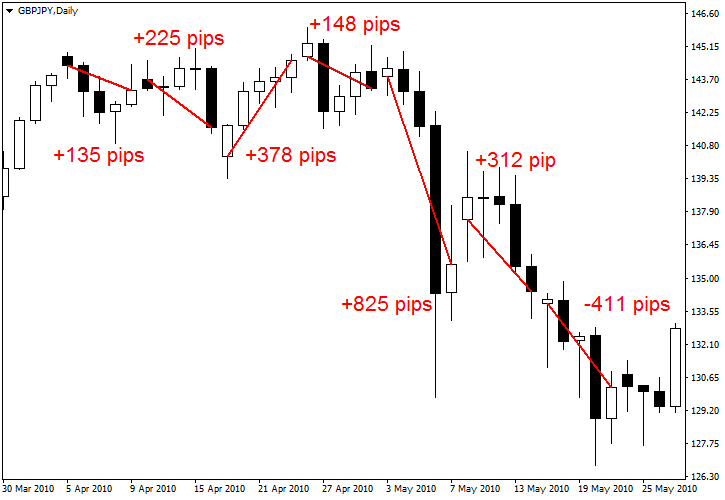
You can see GBP/JPY pair's last 7 weeks (as of May 24, 2010) and all of them have gaps. 6 out of 7 gaps give correct signals that result in a lot of profit. The last gap gives a wrong signal and yields a medium loss. The average spread for GBP/JPY was 3 pips during the example period and all gaps were much wider than 15 pips, making them all qualifying signals. The net total profit was 1,612 pips in 7 weeks — not that bad.

Forex News

High impact Forex news trading strategy (also called news volatility straddle) was developed specifically to trade important Forex news with as little risk as possible. It can be used only for influential Forex news releases such as US GDP, non-farm payrolls, or interest rate decisions. Although all currency pairs react to such news, the USD-based currency pairs show the best result due to low spread and high liquidity.

Features

  • Circumvents spread widening and slippage problems.
  • Fundamental basis for a trade.
  • Simple setup.
  • High success rate.
  • Important news events are quite rare.
  • A broker with low spreads and high quality trade execution is required.

How to Trade?

  1. Choose an important news release that has a high impact on Forex pairs.
  2. For EUR/USD, I recommend US GDP, US nonfarm payrolls, US interest rate decisions, Eurozone interest rate decisions, and US PCE reports.
  3. Open Buy and Sell positions one minute before the scheduled news release. It will help you to protect the trade from slippage and widened spreads.
  4. Set stop-loss for both positions to 10-20 standard pips depending on the expected news volatility.
  5. Set take-profit for both positions to 5 × SL. It will provide the necessary risk-to-reward ratio.
  6. The news volatility will most probably trigger one trade's stop-loss and the other's take-profit.
  7. Move the surviving position's stop-loss to breakeven once the paper profit reaches original stop-loss distance.
  8. Close any positions left one hour after the news.
If your broker uses "first in, first out" (FIFO) execution model, it is still possible to trade news with this strategy. Place pending orders with entry points at the levels you would set the stop-loss of the original Buy/Sell positions. When one pending order is triggered, the other one should be canceled. This strategy modification is required to use it in MetaTrader 5. Unfortunately, it suffers from additional exposure to widened spreads and slippage.

Example

News Trading Strategy Example Chart
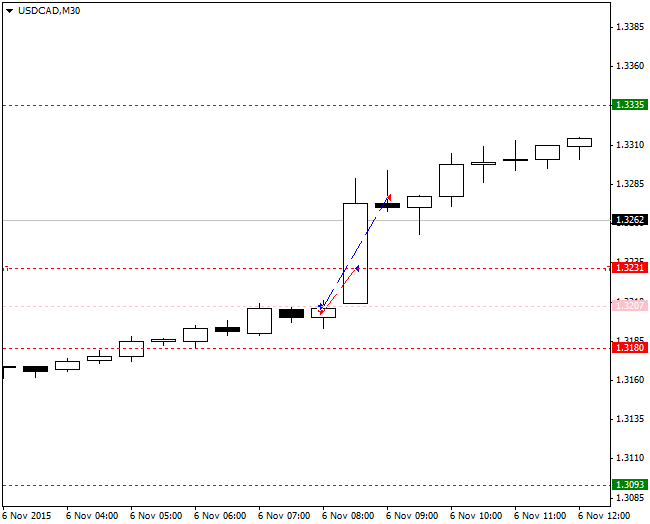
The example depicts a trade on USD/CAD @ M30 chart during a joint announcement of the US and Canadian unemployment figures for October at 13:30 UTC on November 6, 2015:
  1. The entries are shown with the blue and red arrows pointing right.
  2. The blue one is Buy; the red one is Sell.
  3. The original stop-loss levels are the red lines above and below the entries.
  4. The pink line is the Buy trade's stop-loss after it was moved to breakeven.
  5. The take-profit levels are the green lines above and below the entries.
  6. The Sell was closed by stop-loss during the first second after release. The exit is marked with the red arrow pointing left.
  7. The Buy was closed by time-out an hour after the news. It failed to reach the target level but still earned enough profit to cover the loss on Sell and produce a significant reward. The exit is marked with the blue arrow pointing left.

MA Cross Trading Strategy

Moving Average Cross Forex trading strategy — is a simple system that is based on the cross of the two standard indicators — the fast EMA (exponential moving average) and the slow EMA. You can also use our free Adjustable Moving Average Cross expert advisor to trade this strategy automatically in MetaTrader platform.

Features

  • Very easy strategy to follow.
  • Simple indicators used.
  • It's easy to set stop-loss.
  • Moving averages are laggy — can lag up to 10 bars.
  • Ineffective during the flat markets.

Strategy Set-Up

  1. Any currency pair and timeframe should work.
  2. Add an exponential moving average to the chart, set its period to 9, apply to Close, set color to red (optional) — this is your fast moving average (FMA).
  3. Add another exponential moving average to the chart, set its period to 14, apply to Close, set color to blue (optional) — this is your slow moving average (SMA).

Entry Conditions

Enter Long position when FMA crosses SMA from below.
Enter Short position when FMA crosses SMA from above.

Exit Conditions

Stop-loss for Long positions should be set to the Low of the last candle before the cross occurred. For Short positions — to the High of the last candle before the cross.
Take-profit should depend on the stop-loss and should be not less that stop-loss. I recommend setting TP to 1.5 * SL or 2 * SL.
If another cross appears before the stop-loss or take-profit are triggered, close the position.

Example

Moving Average Cross Strategy Example Chart
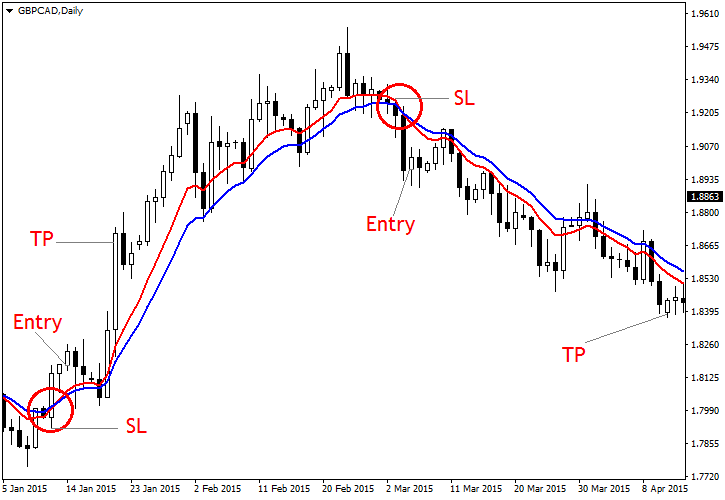
As seen on the example chart, entry conditions are quite clear and with the proper TP/SL ratio, this strategy can be quite profitable.

Simple Price Based Forex trading system

Simple Price Based Forex trading system — an interesting system that was developed by one of the Forex traders recently. It works for any pair (though, EUR/USD is recommended) and in all market conditions. No indicators are required to trade using this system. All you need is the ability to set up the pending orders.

Features

  • Position-based trading for any state of the market.
  • Trailing stop protects profit.
  • Lack of statistical proof.

How to Trade?

  1. Higher timeframe chart is recommended as each trading setup requires some calculations based on the latest bar.
  2. Key number should be calculated first. It's based on the current price. For the quotes with 4 digits after a dot the key value is the current price multiplied by 10 and then rounded. For the quotes with 2 digits after a dot the key value is the current price divided by 10 and the rounded.
  3. Place pending Buy order at Current Price + (2 × Key value).
  4. Place pending Sell order at Current Price − (2 × Key value).
  5. Place stop-loss for pending Buy order at Open Price − (2 × Key value).
  6. Place stop-loss for pending Sell order at Open Price + (2 × Key value).
  7. Take-profit for both orders is calculated similarly to the key value but the current price should be multiplied by 100 for the quotes with 4 digits after a dot and shouldn't be divided for the quotes with 2 digits after a dot. In both cases the values should be rounded.
  8. Trailing stop is also applied to the orders and is set to 2.5 × Key value.
  9. Don't forget to cancel the untriggered orders after the timeframe period ends.
  10. If this sounds too complicated, see the example below.

Example

Simple Price Based Trading System Example Chart
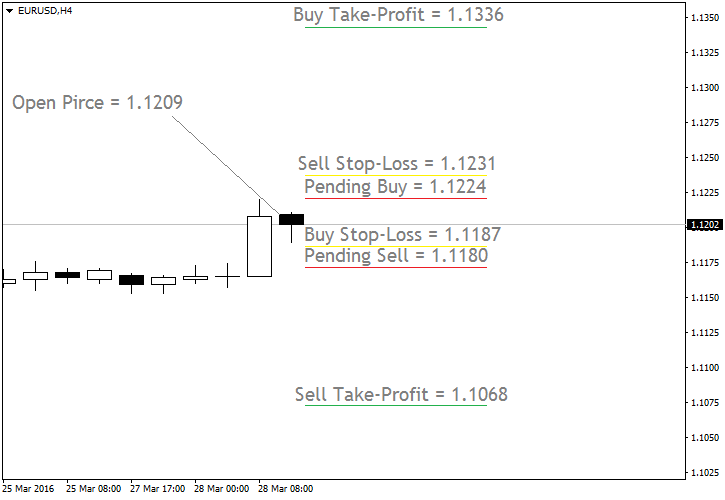
Let's calculate the entry conditions and parameters for an example presented on the chart:
  1. It's a EUR/USD H4 chart.
  2. The current price is 1.1202, the current bar's open price is 1.1209.
  3. There are 4 digits after a dot in the quotes for EUR/USD. That means that the Key value is calculated as 1.1202 × 10 = 11.2. Rounding it results in 11 pips.
  4. Pending Buy order level is calculated as 1.1202 + (2 × 11) = 1.1224.
  5. Pending Sell order level is calculated as 1.1202 − (2 × 11) = 1.1180.
  6. Stop-loss for pending Buy order is calculated as 1.1209 − (2 × 11) = 1.1187.
  7. Stop-loss for pending Sell order is calculated as 1.1209 + (2 × 11) = 1.1231.
  8. Take-profit for all pending orders is calculated as 1.1202 × 100 = 112.0 or, after rounding, 112 pips.
  9. Take-profit for pending Buy order is set to 1.1224 + 112 = 1.1336.
  10. Take-profit for pending Sell order is set to 1.1180 − 112 = 1.1068.
  11. Trailing stop for both orders is set to 2.5 × 11 = 27.5 or, after rounding, 28 pips.
This trading system was originally developed by The Forexkid

Forex trading strategy

Forex exchanging can't be reliably gainful without clinging to some Forex methodology. It requires investment and push to manufacture your own exchanging technique or to adjust a current one to your exchanging needs and style. 

What Is a Trading Strategy? 

Most as often as possible, an exchanging methodology is an arrangement of section and leave rules, which a dealer can use to open and close positions in the outside trade showcase. This tenets can be extremely basic or exceptionally unpredictable. Basic procedures for the most part require just couple of affirmations, while propelled methodologies may require various affirmations and signs from various sources. 

Moreover, an exchanging technique may contain some cash administration principles or rules. A few procedures (e.g. Martingale) can be revolved entirely around position measuring procedures. 

Aside from the section/leave rules and discretionary cash administration rules, techniques are frequently portrayed by the rundown of exchanging apparatuses required to utilize the given procedure. These instruments are generally graphs, specialized or key pointers, some market information or whatever else that can be utilized as a part of exchanging. While picking a system, you have to comprehend, which of the required apparatuses you have under lock and key. 

It is critical to pick a technique or framework that is anything but difficult to take after with your every day exchanging plan and that can be connected effectively with your record adjust estimate.